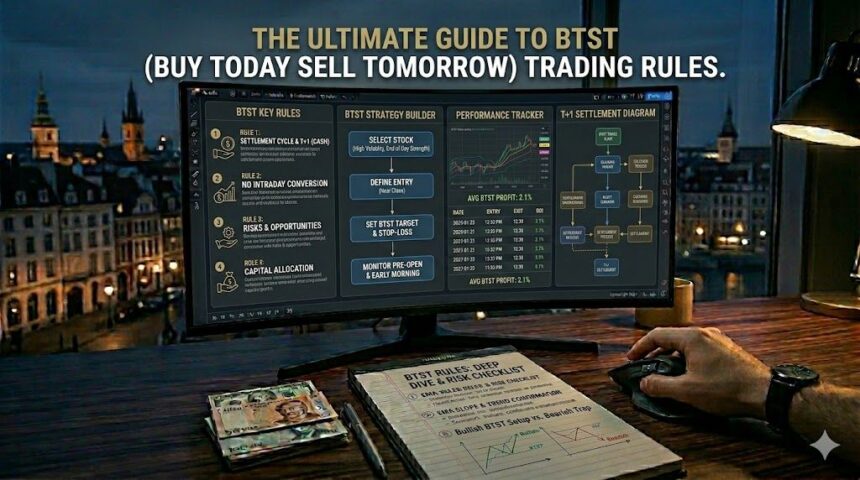
Hey guys, SamacharDesi Editorial Team here, your trusted source for cutting-edge market insights and personal finance strategies. As we look ahead to 2026, the world of stock market trading continues to evolve at a blistering pace. Today, we’re diving deep into a fascinating and potentially lucrative segment: BTST (Buy Today Sell Tomorrow) trading rules. If you’re looking to capitalize on short-term market movements and optimize your personal finance decisions, this ultimate guide is precisely what you need.
- Understanding BTST (Buy Today Sell Tomorrow) Trading in 2026
- Essential BTST Trading Rules and Guidelines for 2026
- 1. Robust Stock Selection Criteria
- 2. Advanced Technical Analysis for Entry and Exit
- 3. Strict Risk Management Protocols
- 4. Understanding Brokerage and Charges in 2026
- Verified Calculations and Example: A BTST Trade Scenario
- BTST vs. Intraday vs. Delivery Trading: A 2026 Comparison
- Leveraging Technology for BTST in 2026
- The Bottom Line: Master Your BTST Journey in 2026
- Frequently Asked Questions (FAQ) about BTST Trading in 2026
BTST trading has gained immense popularity for its unique blend of quick profit potential and minimal overnight holding risk. But make no mistake, it’s not for the faint of heart. Success in BTST requires systematic market guidelines, rigorous risk disclosures, and a keen understanding of data comparisons. Our team has meticulously compiled verified calculations and actionable steps to help you navigate this dynamic trading style effectively in the coming years.
Understanding BTST (Buy Today Sell Tomorrow) Trading in 2026
BTST trading, an acronym for Buy Today Sell Tomorrow, is a specific type of equity market strategy where a trader buys shares on one trading day and sells them on the very next trading day, without taking actual delivery of the shares into their demat account. This strategy became particularly prominent with the shift to T+1 settlement cycles, allowing traders to sell shares even before they are officially delivered to their account. In 2026, with increasingly sophisticated trading platforms and real-time data analytics, BTST continues to be a powerful tool for short-term traders.
Why BTST Trading Appeals to Modern Traders
- Quick Profit Potential: The primary allure of BTST strategy is the opportunity to book profits from short-term price fluctuations within a single trading day cycle.
- Reduced Overnight Holding Risk: Unlike positional or delivery trading, BTST traders avoid holding shares for multiple days, thereby minimizing exposure to major market gaps or unforeseen global events that occur over weekends or extended periods.
- Leverage on Market Momentum: BTST allows traders to capitalize on strong intraday momentum that is expected to continue into the next morning, particularly after significant news events or technical breakouts.
Essential BTST Trading Rules and Guidelines for 2026
To master BTST trading, adherence to a strict set of rules and a robust methodology is paramount. These guidelines are designed to mitigate risks and enhance your chances of profitability.
1. Robust Stock Selection Criteria
- High Liquidity: Always choose stocks with high trading volumes. This ensures you can enter and exit positions easily without significant price impact. Low liquidity can lead to higher slippage and difficulty executing trades at desired prices.
- Volatility Analysis: Focus on stocks that exhibit sufficient daily volatility to offer meaningful profit opportunities. However, avoid excessively volatile stocks that can lead to unpredictable swings and substantial losses. Utilize advanced charting tools in 2026 to assess historical volatility trends.
- News-Driven Momentum: Stocks reacting positively to breaking news (e.g., strong quarterly results, positive sector outlook, new product launches) often carry momentum into the next trading session. Verify the news source and its potential impact.
2. Advanced Technical Analysis for Entry and Exit
Successful BTST traders rely heavily on technical indicators to identify optimal entry and exit points.
- Candlestick Patterns: Look for strong bullish candlestick patterns at market close, such as a large bullish engulfing, marubozu, or morning star, especially when supported by significant volume. These often signal continued upward momentum.
- Volume Confirmation: A surge in trading volume accompanying a price breakout is a strong indicator of conviction. Always confirm price action with volume analysis.
- Support and Resistance Levels: Identify key support and resistance levels. Buying near a strong support level or immediately after a breakout above resistance can be a profitable BTST strategy.
- Indicator Combinations: Use a combination of indicators like the Relative Strength Index (RSI) for momentum, Moving Averages (e.g., 20-period EMA) for trend direction, and MACD for crossover signals. Ensure these indicators align for a higher probability trade setup.
3. Strict Risk Management Protocols
This is arguably the most critical aspect of BTST trading. Without stringent risk management, even a few bad trades can decimate your capital.
- Stop-Loss Orders: Always, and we mean always, place a stop-loss order immediately after entering a BTST trade. A common practice is to place it below a recent swing low or a significant support level.
- Position Sizing: Never allocate more than a small percentage (e.g., 1-2%) of your total trading capital to a single BTST trade. This protects your portfolio from significant losses on any individual trade.
- Risk-Reward Ratio: Aim for a minimum 1:2 risk-reward ratio. This means for every 1 unit of risk you take, you aim for at least 2 units of potential profit.
- Capital Allocation: Understand your overall capital limits. Only trade with disposable income you can afford to lose.
- Market Monitoring: Stay updated on global market cues, economic data releases, and company-specific news, as these can dramatically impact prices overnight.
4. Understanding Brokerage and Charges in 2026
While BTST trading offers quick gains, it also incurs brokerage and transaction charges. In 2026, many discount brokers offer competitive rates, but it’s crucial to factor in all costs:
- Brokerage Fees: Often a flat fee per order or a percentage of the trade value.
- STT (Securities Transaction Tax): Applicable on both buy and sell sides.
- Transaction Charges: Levied by exchanges (NSE/BSE).
- SEBI Turnover Fees: A small fee charged by the regulator.
- GST: Applicable on brokerage and transaction charges.
- Stamp Duty: Varies by state.
Always calculate the breakeven point to ensure your expected profit covers all these charges.
Verified Calculations and Example: A BTST Trade Scenario
Let’s walk through a hypothetical BTST trade in 2026 to illustrate the calculations involved.
Scenario: You identify a stock, “TechCorp Ltd.” (TCL), closing strong on Tuesday, December 15, 2026, at INR 500, with high volume, indicating a potential upward move the next day.
- Entry: Buy 100 shares of TCL at INR 500 on Tuesday.
- Capital Invested: 100 shares * INR 500 = INR 50,000.
- Stop-Loss: You decide to place a stop-loss at INR 495 (a 1% risk tolerance).
- Target Price: Based on technical analysis, you aim for INR 508 (a potential 1.6% profit).
- Brokerage & Charges (Estimated for 2026): Let’s assume total charges amount to INR 50 per side (buy/sell).
Next Day (Wednesday, December 16, 2026):
- Case 1: Target Hit (Successful Trade)
- TCL opens higher and reaches INR 508. You sell 100 shares at INR 508.
- Sell Value: 100 shares * INR 508 = INR 50,800.
- Gross Profit: INR 50,800 – INR 50,000 = INR 800.
- Total Charges: INR 50 (buy) + INR 50 (sell) = INR 100.
- Net Profit: INR 800 – INR 100 = INR 700.
- Return on Capital: (700 / 50,000) * 100 = 1.4%.
- Case 2: Stop-Loss Hit (Unsuccessful Trade)
- TCL opens lower or reverses and hits your stop-loss at INR 495. You sell 100 shares at INR 495.
- Sell Value: 100 shares * INR 495 = INR 49,500.
- Gross Loss: INR 50,000 – INR 49,500 = INR 500.
- Total Charges: INR 50 (buy) + INR 50 (sell) = INR 100.
- Net Loss: INR 500 + INR 100 = INR 600.
- Loss on Capital: (600 / 50,000) * 100 = 1.2%.
This example highlights the importance of managing your risk and ensuring your potential profit outweighs your potential loss.
BTST vs. Intraday vs. Delivery Trading: A 2026 Comparison
Understanding where BTST fits in the broader trading landscape is crucial for informed personal finance decisions. Here’s a comparison:
| Feature | BTST (Buy Today Sell Tomorrow) | Intraday Trading | Delivery Trading |
|---|---|---|---|
| Holding Period | 1 Trading Day (Buy T, Sell T+1) | Less than 1 Day (Buy T, Sell T) | Multiple Days/Weeks/Months/Years |
| Delivery of Shares | No physical delivery to demat | No physical delivery to demat | Shares delivered to demat account |
| Overnight Risk | Yes, for one night | No (positions squared off same day) | Yes, for multiple nights |
| Margin/Leverage | Often requires full cash for purchase (or specific BTST margin) | Significant leverage usually available | Full capital required (no leverage for holding) |
| Capital Required | Moderate to High | Low (due to leverage) | High (full value of shares) |
| Profit Potential | Moderate (short-term swings) | High (quick, frequent trades) | High (long-term growth, compounding) |
| Risk Level | Moderate to High (due to overnight gap risk) | High (due to leverage and speed) | Low to Moderate (long-term market resilience) |
| Market Knowledge | Technical Analysis, News Flow | Technical Analysis, Speed of Execution | Fundamental Analysis, Macro Economics |
Leveraging Technology for BTST in 2026
The technological landscape in 2026 offers unprecedented tools for BTST traders:
- AI-Powered Analytics: Utilize platforms offering AI-driven insights for identifying high-probability BTST candidates based on historical data and real-time news sentiment.
- Advanced Charting Tools: Integrated platforms with customizable indicators, multi-timeframe analysis, and direct order placement from charts.
- Real-time Data Feeds: Ensure your brokerage provides lightning-fast data to react instantly to market movements.
- Algorithmic Trading (for experienced traders): For highly sophisticated traders, consider pre-defined algorithms to execute BTST strategies based on specific conditions, reducing emotional bias.
The Bottom Line: Master Your BTST Journey in 2026
BTST trading, when approached with discipline, knowledge, and stringent risk management, can be an exciting avenue for short-term gains in the dynamic markets of 2026. Remember, it’s not about making every trade a winner, but about managing your losses effectively and letting your winners run. Educate yourself, practice consistently, and always adapt your strategies to evolving market conditions.
The SamacharDesi Editorial Team encourages you to thoroughly research any stock before committing capital, backtest your strategies, and start with small positions. Your journey to becoming a successful BTST trader begins with informed decisions and unwavering discipline. Happy trading!
Frequently Asked Questions (FAQ) about BTST Trading in 2026
1. Is BTST trading legal and regulated in India (or equivalent market) in 2026?
Yes, BTST trading is perfectly legal and regulated by SEBI (or the relevant financial authority in your region). It operates within the standard T+1 settlement cycle. Always ensure you are trading with a SEBI-registered broker.
2. What is the maximum risk I should take on a single BTST trade?
As a general rule for personal finance decisions, it’s advisable not to risk more than 1% to 2% of your total trading capital on any single trade. This approach helps protect your principal capital from significant drawdowns.
3. What are the best indicators for identifying BTST opportunities?
Effective indicators for BTST strategy include high trading volume accompanying bullish candlestick patterns (e.g., strong closes), Relative Strength Index (RSI) for momentum, Moving Averages (especially the 20-period EMA for short-term trend), and MACD crossovers. Combining these offers stronger signals.
4. Can I convert a BTST trade into a delivery trade?
Yes, you can. If you buy shares in a BTST transaction and decide not to sell them the next day, they will be delivered to your demat account. At this point, it transitions into a delivery trade, and you will need to have sufficient funds to take full delivery of the shares.
5. What happens if I don’t sell my BTST shares the next day?
If you don’t sell your BTST shares on the next trading day (T+1), the shares will be credited to your demat account, effectively converting your position into a regular delivery holding. You will then be able to sell them anytime thereafter as a delivery sale.
6. What are the common reasons for BTST trades to fail?
Common reasons for BTST trade failures include unexpected negative market news overnight, global market crashes, poor stock selection (low liquidity, excessive volatility), lack of proper risk management (no stop-loss), and emotional trading decisions.
7. Are there specific sector preferences for BTST trading?
While BTST can be applied across sectors, traders often favor sectors known for their high liquidity and responsiveness to news, such as IT, Banking, Pharma, and certain large-cap manufacturing or consumer goods stocks. It’s more about the individual stock’s momentum and liquidity than its sector.
Written by SamacharDesi Editorial Team
Official editorial intelligence team. We monitor, cross-verify, and publish high-utility reviews, guides, job alerts, and scheme parameters under strict factual verification guidelines.